The question of how long are retreats often arrives when someone realizes that a massage, a free afternoon, or even a vacation has not quite touched what feels heavy. You may be functioning well on the surface while feeling far from yourself underneath. In that moment, choosing a retreat is not only about finding time in the calendar. It is about honoring the amount of space your body, heart, and life may need.
Retreats can last a single day, a weekend, several nights, or a week or more. There is no universally right length. The most supportive choice depends on what has brought you to the threshold, how much privacy and restoration you need, and what kind of care will help you return home feeling more connected rather than simply briefly relieved.
How long are retreats, usually?
A retreat may be as short as a few hours or as spacious as several weeks. Day retreats are often designed around a focused experience, such as meditation, sound healing, gentle movement, or reflection. They can offer a meaningful pause, particularly when life is full and travel is not possible.
Overnight retreats commonly range from two to four nights. This is a natural rhythm for many guests: enough time to leave the pace of ordinary life, sleep deeply, spend time in nature, and settle into more personal reflection. A three-night stay, for example, often gives the nervous system a chance to recognize that it does not have to stay on alert. The first day may be about arriving. The next can bring greater presence. By the final day, there is often more room to listen inwardly without rushing toward an answer.
Longer retreats of five to seven nights, or beyond, can be especially valuable during a significant transition. Grief, burnout, a relationship change, a major decision, or a season of feeling lost can ask for more than a quick reset. More time does not guarantee a deeper experience, but it can create a gentler pace in which insight is not forced and rest is not treated as an afterthought.
Why the first day can feel different from the last
Many women arrive carrying more momentum than they realize. There are messages unanswered, responsibilities waiting, and the familiar habit of scanning for what needs to happen next. Even in a beautiful setting, the mind may take time to follow the body into rest.
This is not a failure to relax. It is a very human response. When we have lived through prolonged stress, the nervous system can become practiced at vigilance. A quiet room, a forest path, or the rhythmic sound of waves may feel soothing, yet the body may need repeated experiences of safety before it fully softens.
That is why a retreat of several nights can feel different from a short escape. There is time to move beyond the initial exhale. Sleep may become more restorative. Meals can be slower. The emotional material that has been held at bay may become easier to notice, not because it has been summoned, but because there is finally room for it.
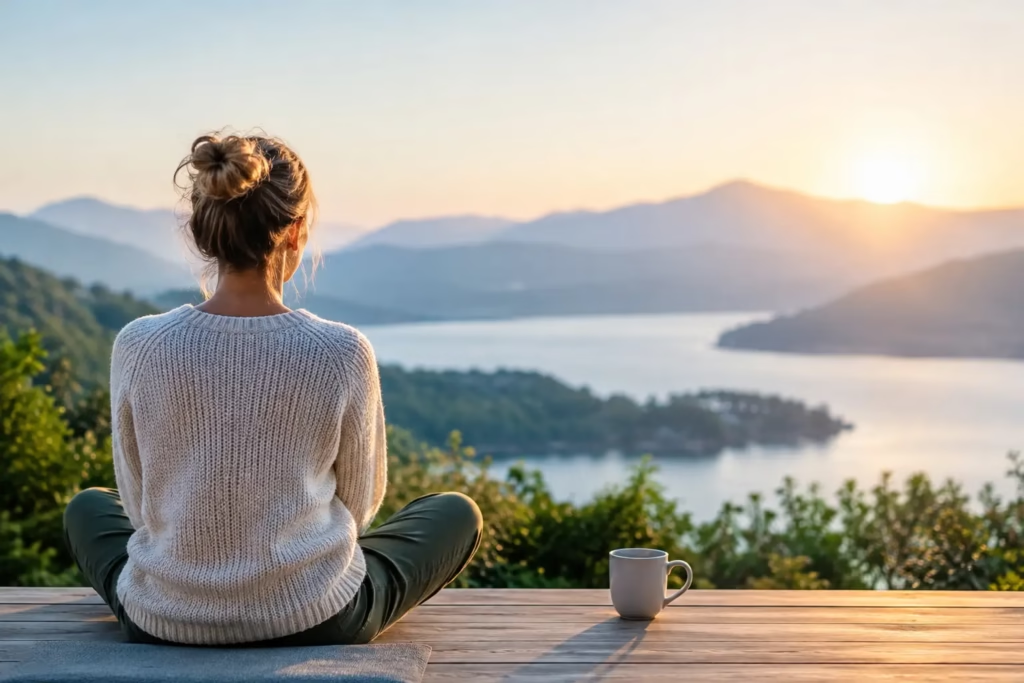
At an intimate setting such as Serenity By The Sea, the oceanfront landscape is part of this rhythm. Endless ocean vistas, forest melodies, and a private place to rest are not decorations around the experience. They can become quiet companions, offering the senses something steady and life-giving to return to between conversations, treatments, or moments of solitude.
Choosing a retreat length for what you need now
A one-day retreat may be right when you need a clear interruption to your routine or want to reconnect with a practice that already supports you. It can be a thoughtful beginning, but it may not leave enough time for a deeper emotional settling, especially if travel or a demanding home life surrounds it.
Two nights can offer a welcome reset. This length tends to suit someone who needs rest, nourishment, and perspective but has limited time away. It can be particularly meaningful when the retreat is close enough that the journey does not consume the experience. The trade-off is that the stay may feel just as you are beginning to land.
Three or four nights often create a more spacious container for personal healing work. This is a supportive length for women who have been holding a great deal, who want individual guidance alongside unstructured rest, or who sense that clarity is present but buried beneath constant activity. There is time for both meaningful sessions and the unscheduled moments when the ocean, a warm bath, or an early night does its quiet work.
A week or longer may be appropriate when you are navigating a profound transition, recovering from extended burnout, or seeking to step away from the environment that continually pulls you into old patterns. Still, longer is not always better. A seven-night retreat may be too much if being away brings more strain than ease, or if you are new to personal retreat and need to begin with a smaller commitment. The goal is not to prove your devotion to healing. It is to choose a length that feels honest and sustainable.
Consider the transition time, too
When deciding how long a retreat should be, include the days around it. If possible, avoid returning directly from deep rest to a packed workday, a major family event, or an airport sprint. A little breathing room after a retreat allows insights to become part of ordinary life.
You might keep the first evening home quiet, protect your sleep, spend time outside, or write down what you want to remember. Integration is not a task to complete. It is the gradual practice of meeting your daily life with a little more awareness and choice.
The difference between a getaway and a healing retreat
A beautiful getaway can be restorative. Comfort, privacy, and nature have their own medicine. Yet a personalized healing retreat offers something additional: intentional relationship. Rather than following a crowded schedule or trying to keep up with a group, you are invited to meet what is true for you.
For some women, that may mean life-coaching-oriented conversation that brings language to a long-held crossroads. For others, it may include somatic practices, sound, gentle clearing work, Hawaiian healing traditions, or simply time to be quiet after years of being needed by others. A trauma-informed approach does not demand disclosure or push for catharsis. It respects pace, consent, and the wisdom of the body.
This is also why retreat length should reflect the nature of the experience. If you are coming for personal sessions and hope to make space for rest in between, a few nights often serve you better than attempting to compress everything into one intense day. Reflection needs pauses. The body often understands before the mind can explain.
Signs you may benefit from a longer stay
You do not need to be in crisis to choose more time. Often, the clearest sign is subtler: you cannot remember the last time you were alone without needing to recover from something or prepare for someone else.
A longer retreat may be supportive if rest has begun to feel unproductive, if you are moving through grief or change, or if you have gathered plenty of insight but struggle to feel it in your body and decisions. It can also be valuable when you are at the beginning of a new chapter and want to hear your own voice before outside opinions rush in.
At the same time, no retreat length can replace ongoing medical, mental health, or community support when those are needed. A retreat can be a meaningful part of a larger circle of care, not a requirement to heal alone or all at once.
Give yourself permission to choose enough time
The best retreat length is often the one that allows you to arrive without hurrying and leave without abandoning yourself. For one person, that may be a nourishing weekend. For another, it may be four quiet nights on a cliffside, with the sound of the sea marking the hours and no pressure to perform wellness.
You do not have to earn rest by reaching exhaustion first. Sometimes the most loving decision is simply to make enough room to hear what your own life has been trying to tell you.