A woman can understand exactly why she is exhausted and still feel unable to rest. She may have read the books, spoken with a therapist, held herself together through a demanding season, and yet notice that her body remains braced for what comes next. This is often where the question of Hawaiian healing versus reiki arises: not as a search for a magical answer, but as a desire to feel more at home within oneself.
Both practices are often described as energy healing, and both may offer a quiet, restorative experience. Yet they come from different cultural lineages, carry different intentions, and can feel quite different in the room. Knowing those distinctions can help you choose with more discernment, especially when you are seeking care that feels personal, respectful, and emotionally safe.
Hawaiian Healing Versus Reiki: The Essential Difference
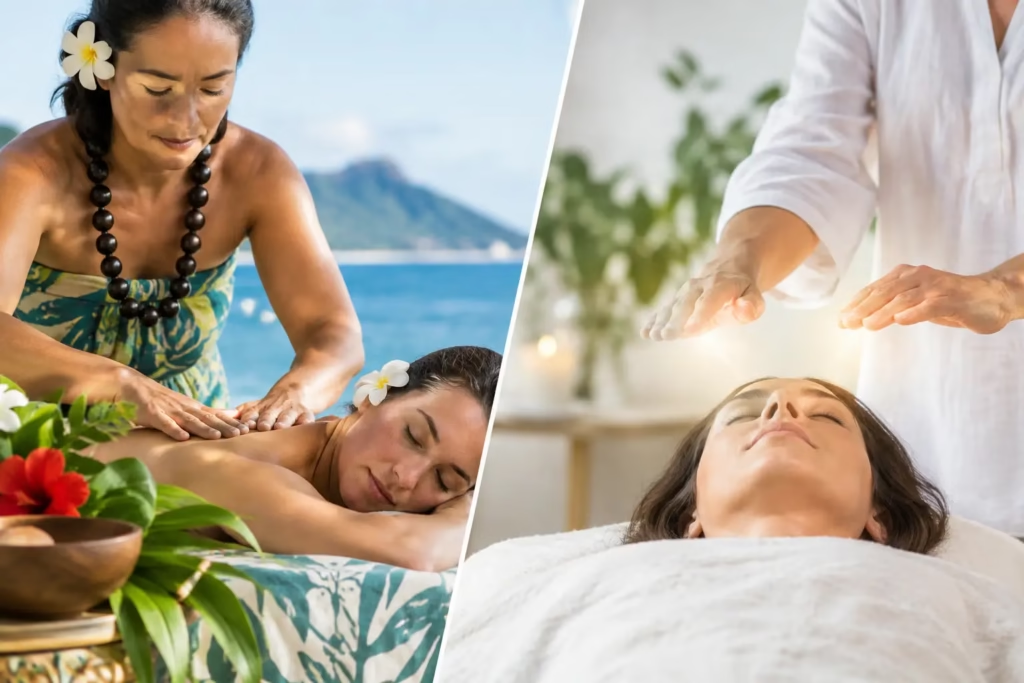
Reiki is a Japanese practice developed in the early 20th century by Mikao Usui. In a typical session, the practitioner places their hands lightly on or just above the body in a series of positions. The setting is usually calm and still. Many people describe warmth, tingling, deep relaxation, emotion, or simply a rare opportunity to be quiet without needing to explain themselves.
Hawaiian healing is not one single modality with one universal method. It is a broad term that can refer to practices rooted in Native Hawaiian cultural and spiritual traditions. Depending on the practitioner and their training, a session may include prayer or intention, breath, movement, hands-on bodywork, sound, guided reflection, forgiveness practices, and connection with nature, ancestry, or relationship.
That distinction matters. Reiki generally follows a recognizable session structure, while Hawaiian healing is often more relational and individualized. A practitioner may listen closely to what is present in your life – grief, a transition, an old pattern of overgiving, a loss of direction – and shape the experience around that context. It may be less about receiving a treatment and more about being met as a whole person.
Neither approach needs to be framed as better. The more useful question is: what kind of support feels true for you right now?
Roots, Culture, and Respectful Practice
Reiki has traveled widely beyond Japan, and many modern practitioners work in styles that vary from the original Usui tradition. It is still wise to ask where someone trained, how they describe their work, and what a session includes. Clear answers are a sign of care.
With Hawaiian healing, cultural respect deserves particular attention. Terms such as lomilomi and hoʻoponopono are sometimes used broadly in wellness spaces, even when detached from the values, relationships, and cultural context that give them meaning. Traditional Hawaiian knowledge is not a decorative collection of techniques. It is connected to place, family, reciprocity, spirituality, and ways of living in right relationship.
A thoughtful practitioner will not present Hawaiian healing as an exotic shortcut or claim to represent a tradition they have not been entrusted to carry. They will be transparent about their lineage, teachers, scope, and the specific practices they offer. They will also make room for your own beliefs and boundaries rather than asking you to adopt theirs.
This does not mean you must become an expert in cultural history before receiving a session. It means you are allowed to be curious. You might ask, “How were you trained?” “What traditions inform this work?” or “What does this practice ask of me, if anything?” A caring guide will welcome those questions.
What Each Experience May Feel Like
A Reiki session often begins with a brief conversation about your intention, followed by rest on a massage table, fully clothed. The practitioner may work silently or use soft music. Because there is usually minimal dialogue during the session, Reiki can suit someone who feels mentally overloaded and wants spaciousness without having to find the right words.
Some people experience Reiki as settling and comforting. Others feel very little in the moment but sleep deeply afterward or notice greater emotional clarity over the following days. And some people simply enjoy an hour of intentional rest. All of these are valid responses.
Hawaiian-informed healing can be equally quiet, but it may also be more active or expressive. A session could include intentional touch, breathwork, gentle movement, conversation, prayer, chanting, or a clearing ritual. If lomilomi-inspired bodywork is part of the experience, the touch may be flowing and rhythmic, sometimes using forearms as well as hands. A practitioner should always explain what is proposed and receive your ongoing consent.
For a woman who has spent years adapting to everyone else, this is not a small detail. The ability to say yes, no, slower, or not today can be part of the healing experience itself. Trauma-informed care recognizes that safety is not created by a beautiful room alone. It is created through choice, pacing, privacy, and a relationship in which your body is believed.
What Science Can and Cannot Say
Research has not established that Reiki or Hawaiian healing practices can diagnose, cure, or treat medical conditions. Claims that a practitioner can remove disease, guarantee transformation, or replace medical or mental health care deserve caution.
At the same time, the benefits people describe should not be dismissed simply because they are difficult to measure in a laboratory. Gentle touch, quiet attention, meaningful ritual, time in nature, and the expectation of care can all influence how the nervous system experiences safety. When the body senses less threat, breath may deepen, muscles may soften, and emotions that have been held at a distance may become easier to notice.
That does not make every experience profound, nor does it mean relaxation resolves the source of every struggle. It does suggest why supportive practices can be valuable alongside therapy, medical care, medication when needed, and the practical changes that real life sometimes requires.
A trustworthy practitioner will speak plainly about these limits. They will encourage you to seek appropriate professional care for persistent pain, depression, trauma symptoms, or other health concerns. Spiritual support and responsible care can belong in the same life.
How to Choose Between Hawaiian Healing and Reiki
If you are craving stillness, quiet touch or hands held above the body, and a simple format with little conversation, Reiki may feel like a gentle place to begin. Its structure can be reassuring when life has felt chaotic. You do not need to believe anything particular to receive a session; curiosity is enough.
If you are seeking a more relational, body-centered experience that may include reflection, movement, cultural or spiritual elements, and a connection to the natural world, Hawaiian healing may resonate more deeply. This can be especially meaningful during a life transition, when the question is not only “How do I relax?” but also “What am I ready to acknowledge, release, or tend?”
Your preferences around touch matter, too. Ask in advance whether the session involves hands-on work, where touch may occur, whether you remain clothed, and how consent is handled. If prayer, sound, or spiritual language is part of the offering, ask how those elements are introduced. You deserve to know what you are choosing.
It can also help to notice the quality of the practitioner’s presence before you book. Do they make grand promises, or do they speak with humility? Do you feel pressured to return, or supported in listening to your own timing? Do they have room for complexity, including the possibility that a session may bring up tenderness rather than immediate relief? A grounded guide will not ask you to give away your discernment.
When Place Becomes Part of the Practice
For some people, a healing session is most supportive when it is held within enough time and beauty to let the experience settle. The nervous system rarely shifts on command. It often responds gradually: to unhurried mornings, rhythmic waves below a cliffside, forest melodies, nourishing food, and the relief of not being needed for a while.
At Serenity By The Sea, Hawaiian healing is offered as part of a deeply personal retreat experience rather than a standardized service. In a private setting on Galiano Island, the work can be held alongside rest, nature, sound, reflection, and the exquisite hospitality of an oceanfront sanctuary. The intention is not to perform transformation, but to create the conditions where your own inner knowing can be heard again.
You do not have to choose the perfect modality or arrive with a polished intention. Begin with what you notice: whether you long for silence, safe touch, honest conversation, movement, prayer, or simply a place where your shoulders can finally lower. That small act of listening is already a meaningful way home.