There is a particular kind of tiredness that a weekend away cannot always reach. It can live beneath a full calendar, a capable exterior, and the familiar habit of caring for everyone else first. When women ask why choose intimate retreats, they are often not looking for more activities or another beautiful place to sleep. They are longing for enough quiet, safety, and personal space to hear themselves again.
A small retreat is not necessarily better for everyone. Some people feel energized by group movement, shared meals, and a full schedule of classes. Yet for those moving through burnout, grief, a life transition, or a season of profound self-questioning, a more private setting can offer something different: room to arrive without having to perform wellness for anyone else.
Why Choose Intimate Retreats Instead of Larger Wellness Resorts?
At a large resort, wellness can be wonderfully abundant. There may be yoga at sunrise, a menu of treatments, a busy spa, and many people who have come for rest. But abundance can also ask a lot of an already overloaded nervous system. New spaces, new faces, fixed appointment times, and the subtle social pressure to make the most of every offering can leave little room to simply be.
An intimate retreat changes the rhythm. With only a few guests, or in a one-to-one setting, the experience can respond to the person rather than asking the person to adapt to a program. Perhaps what is needed is a conversation that is not rushed. Perhaps it is an afternoon without words, a sound bath, a clearing session, a slow walk beneath cedar trees, or the permission to rest without explaining why.
This level of attention is not about being constantly attended to. It is about being held in a way that respects autonomy. Thoughtful hospitality notices the details that support ease – a private entrance, a peaceful suite, nourishing surroundings, and a host who understands that solitude can be as restorative as connection.
Privacy can help the body soften
Many women spend much of their lives being observed, needed, evaluated, or relied upon. Even a pleasant group experience can activate the part of us that monitors how we are coming across. Are we joining in enough? Are we saying the right thing? Do we seem grateful, relaxed, transformed?
Privacy offers a reprieve from that inner vigilance. In trauma-informed work, safety is not simply the absence of danger. It is also the presence of choice, predictability, and enough spaciousness for the body to settle. When there is no need to keep up, make conversation, or hide a tender moment, the nervous system may begin to shift out of constant readiness.
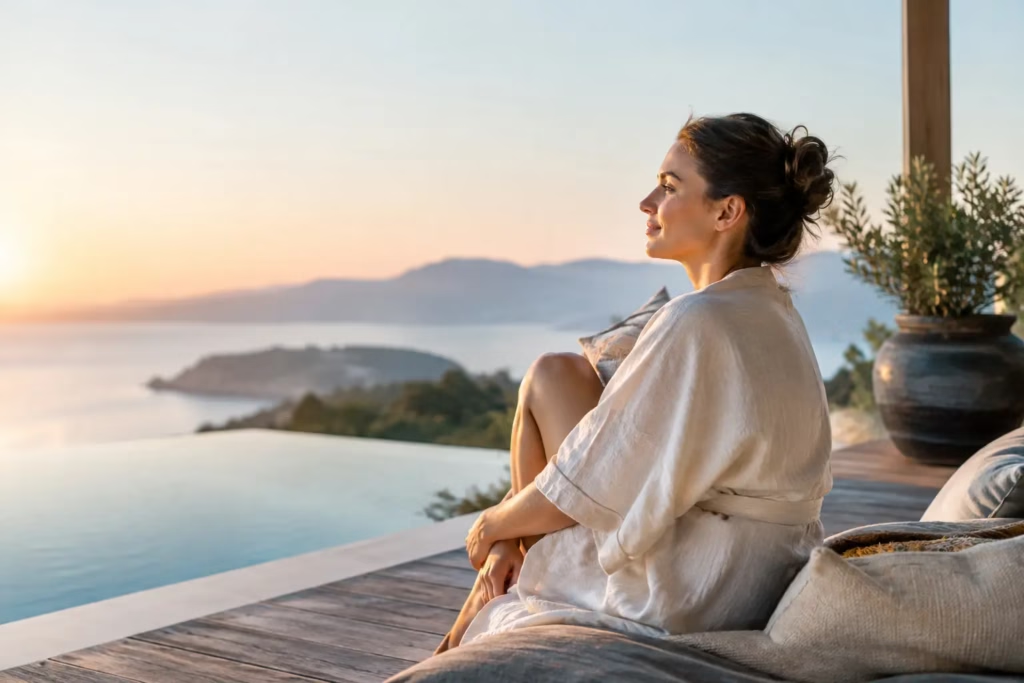
That shift cannot be forced, and no retreat can promise a particular outcome. But the conditions matter. Rhythmic waves against the shoreline, forest melodies beyond the window, warm water, unhurried sleep, and a view that invites the eyes toward the horizon can all gently remind the body that it is allowed to come down from high alert.
Personal Attention Is Not a Luxury Add-On
The word “personalized” is used often in wellness, but its deeper meaning is relational. A truly personal retreat does not begin with an assumption about what should be fixed. It begins with listening.
Two women can arrive carrying what looks like the same concern – exhaustion, anxiety, a relationship crossroads – and need entirely different things. One may be ready to name a long-held truth. Another may first need to feel grounded in her body. One may find clarity through conversation; another through stillness, movement, music, or time in nature.
A skilled, compassionate guide can help make room for this difference. At Serenity By The Sea, personalized healing retreats are shaped one-to-one, drawing from somatic awareness, contemplative practice, neuroscience-informed understanding, Hawaiian healing traditions, and deep relational presence. The intention is not to hand someone a new identity or a rigid answer. It is to create the kind of attentive space where her own knowing can become easier to recognize.
This is especially meaningful for people who have done considerable inner work already. Insight is valuable, yet insight alone does not always change the patterns that live in the body. We can understand why we overwork, overgive, or stay silent, while still feeling pulled into those same responses under stress. Gentle, embodied experiences can help bridge the distance between knowing something intellectually and feeling able to live it.
Nature Gives Reflection Somewhere to Land
A retreat setting is not merely a backdrop for healing work. The natural world can become a quiet companion in it.
On an island, the journey itself creates a threshold. Ferry travel asks us to leave the pace of the city for a while. Cell service may soften. The horizon widens. There is a felt sense of crossing from one rhythm into another, even before any formal session begins.
Oceanfront nature is especially generous with perspective. Waves repeat their ancient work without needing anything from us. Rainforest paths show both stillness and continual change. A cliffside view can make a personal worry feel neither trivial nor all-consuming, but part of a larger human life. For someone accustomed to solving everything through effort, this can be a meaningful reorientation.
There is science behind the intuition that nature calms us. Time in restorative environments can support attention, lower stress responses, and make space for emotional regulation. Yet it is often the ordinary moments that stay with us: holding a warm mug by the window, watching mist move across the water, or noticing that one full breath has become possible again.
Solitude is different from isolation
Choosing an intimate retreat does not mean withdrawing from life forever or avoiding necessary support. Healthy solitude is not disconnection. It is a temporary clearing in which a person can meet herself without the usual noise.
For some, this may include guided support and careful conversation. For others, the healing begins in the hours between sessions, when nothing is being asked of them. The distinction matters. Isolation leaves us feeling unseen and cut off. Intentional solitude, within a safe and welcoming environment, can restore a sense of inner companionship.
The Trade-Off: Fewer Distractions, More Honesty
An intimate experience may not offer the endless dining options, packed entertainment, or anonymity of a large property. It asks for a different kind of participation: not busyness, but presence.
That can feel unfamiliar at first. When the distractions fall away, feelings sometimes become clearer. A woman may notice how tired she really is, how much grief has been waiting for attention, or how deeply she misses a part of herself. This is not a failure of relaxation. It can be the beginning of honest contact.
The right retreat should make room for that honesty without dramatizing it. Look for a setting that values consent, confidentiality, clear boundaries, and an approach that does not confuse intensity with transformation. Healing is not a performance, and it does not need to be rushed to be real.
It is also wise to consider practical fit. If you are seeking an energetic social holiday, a larger group retreat may be more nourishing. If you are in acute crisis or need clinical mental health care, a wellness retreat should complement, not replace, qualified medical or therapeutic support. Discernment is part of self-care.
What Lasting Renewal Often Looks Like
The most meaningful shift may not be a dramatic revelation. It may be recognizing the moment your shoulders rise and choosing to pause. It may be returning home with a clearer boundary, a renewed creative impulse, or a gentler relationship with your own needs.
Lasting renewal is often quiet because it grows through repetition. The calm you experience beside endless ocean vistas can become a memory your body knows how to revisit. The truth you speak in a private session can become easier to honor in an ordinary Tuesday. The rest you allow yourself in a secluded suite can challenge the old belief that your worth depends on how much you carry.
An intimate retreat offers no escape from being human. What it can offer is a one-of-a-kind pause in which your life is allowed to be seen with tenderness, perspective, and care. Sometimes, that is where the next true step becomes visible: not in striving harder, but in remembering that your soul has been waiting patiently for a little room to breathe.